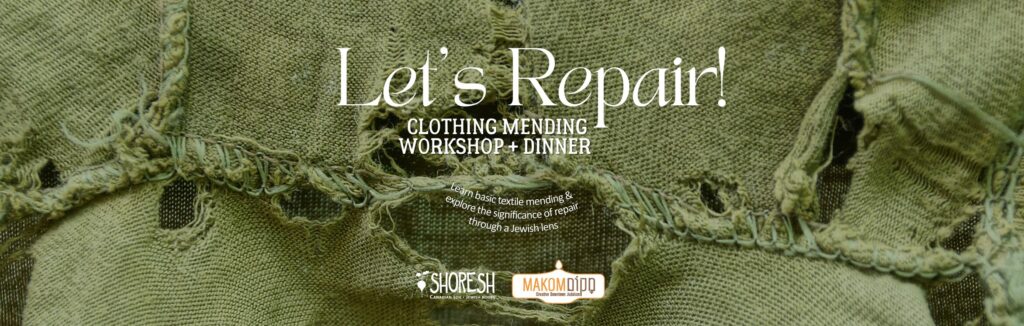
Learn basic textile mending skills and explore the significance of repair, both environmentally and through a Jewish lens.
Wednesday, March 25 | 6:00-8:00 pm – Makom(402 College St)
We’ll begin with a kosher, vegan dinner, followed by a short text study and discussion with Rabbi Aaron. Then, we’ll have an hour of hands-on learning to mend clothing with Shoresh educator Rebecca.
Bring your clothing and textiles that need a little love, and any yarn or materials you have that you’d like to work with.
You’ll receive a basic mending kit you can take home with you, including darning needles, a darning egg, and some yarn swatches you can choose from.
This is a beginner, introductory workshop; no experience necessary! Come learn some new skills, or enjoy an enriching community space to continue your learning.
Please try to arrive on time to maximize our workshop time.
Makom welcomes participants of all abilities. Makom’s main space is wheelchair accessible; unfortunately, the washroom is down a flight of stairs. If you have an accessibility need or require any accommodations, please reach out to us.
Supervised childcare will be provided in Makom’s playroom during services.
After lunch, Naama Baumgarten Sharon will lead an interactive learning session.
Since completing an MA in Bible at the Hebrew university in 2009, Naama has focused her professional efforts on the protection of human rights and advancement of social justice, while continuing to embrace opportunities to learn Torah and find the bridge between these two worlds.
Posted on by Adina in Class, Programs, Uncategorized | Comments Off on Jan 13 & 27; Feb 10 & 24; Mar 10 & 24: House of Searching: the Downtown Beit Midrash
Learn Torah together in an open and supportive environment.
Every other Tuesday: Jan 13 & 27; Feb 10 & 24; Mar 10 & 24 (plus more dates after Passover) 7:00pm: Soup & Socializing 7:30-9:00pm: Learning @Makom (map) Register Now!
This is not a class, but a space for you to:
Enjoy soup and socializing 7:00-7:30pm
Choose a Jewish text that interests you – we have a wide variety, from weekly Torah portion to ethics, mysticism to law, and much more; or bring your own book
Find a havruta (study partner) – come with a friend or we’ll help pair you with someone with a similar interest as you
Sit and learn together – read aloud, ask each other questions, discuss, debate, and reflect
Rabbi Aaron will be your Torah concierge to help you pick a text that works for you, find a havruta, get started, and navigate any difficulties you encounter.
Everyone is welcome, no matter your Jewish learning background!
And of course, LGBTQ+ folks, interfaith couples, and people from interfaith backgrounds are always absolutely welcome.
This program is free. Please help us cover costs by donating when you register.
Our recommended donation amounts are lower for current Makom members. Be part of the Makom community: become a Makom member now.
What’s a Beit Midrash?
Beit Midrash is usually translated as House of Study, a place in which people come together to learn, discuss, and debate Jewish texts of all sorts. But the root of the word “midrash” means searching. When we study Torah, we’re not just trying to comprehend it intellectually, but seeking meaning from it to apply in our lives. Hence, House of Searching.
Why is this important?
As Rabbi Aaron spoke about on Rosh Hashanah, it’s the Torah that gives meaning and substance to being Jewish.
The word Torah literally means “teaching.” It refers not only to the Torah itself (the 5 Books of Moses), but to any Jewish teaching. There are so many ways to learn Torah, whether by reading the parashah (weekly Torah portion), studying the rabbinic debates of the Mishnah and Talmud, examining halakhah (Jewish law), delving into kabbalah (Jewish mysticism), and on and on.
Torah can enlighten us. It can teach us our people’s stories, about Jewish ritual and ethics, the world, each other, God, even ourselves.
Torah – in its fullest sense – is so vast and varied, there’s definitely something that’s just right for you to learn.
Who is this for?
Torah is for all of us! It’s not some secret knowledge just for certain people. As the Torah says about itself: כִּי־קָרוֹב אֵלֶיךָ הַדָּבָר מְאֹד בְּפִיךָ וּבִלְבָבְךָ – “This thing is very close to you, in your mouth and in your heart” (see Devarim 30:11-14). House of Searching is intended for all adults; high school teens are also welcome.
Donations & Sponsorships
Sponsorship opportunities are still available. You may sponsor in honour or memory of someone or to mark a special occasion. Please connect with Rabbi Aaron if you’re interested in supporting this program in general or for a particular week.
Donations are tremendously helpful and greatly appreciated; if you’re able, please contribute.
Posted on by Sarah Raizel in Class | Comments Off on Mar 11: Shabbat Morning Services + Lunch n’ Learn
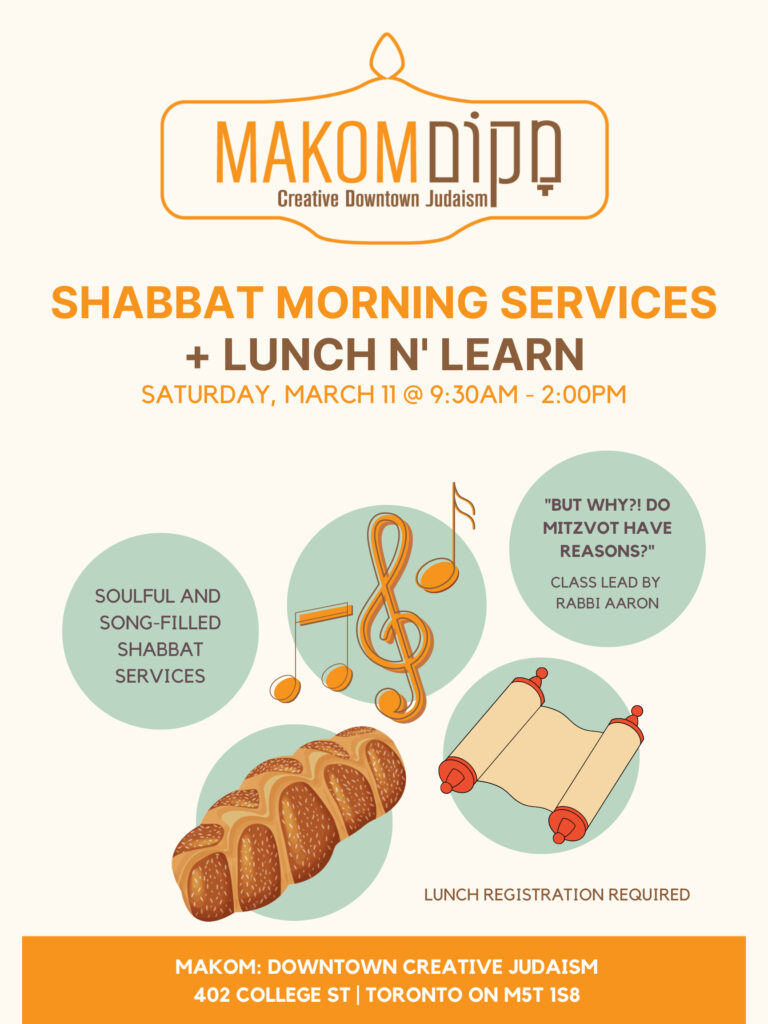
Join us for soulful and song-filled Shabbat morning services, followed by Shabbat lunch and learning!
Saturday, March 11 9:30am – 2:00pm @Makom – 402 College St (map) Services do not require registration. Lunch registration is required – click here to register. Various price options are available so that finances aren’t an impediment to anyone’s participation. Become aMakom Member first and save 10%.
We’ll hear the Torah reading of parashat Ki Tissa (Shemot/Exodus 30:11-34:35), which includes the pivotal episode of the golden calf. There’s also a special, additional Torah reading for Shabbat Parah (literally, cow Shabbat): Bemidbar/Numbers 19:1-22.
Supervised childcare will be provided in Makom’s playroom during services.
At lunch, Rabbi Aaron will guide us in learning “But Why?! Do Mitzvot Have Reasons?” Through text study and discussion, we’ll explore diverse approaches (including our own) to this foundational philosophical question in Judaism. (No prior Jewish learning experience or Hebrew knowledge necessary.)
Please come on time so we can start services strong with a double minyan,* especially for anyone saying kaddish. *As a diverse and inclusive Jewish community, Makom has mens’, womens’, and all-genders’ seating sections. Female, male, and gender non-binary Jews can lead parts of services, read and be called up to the Torah, and count in our double minyanim of both 10 Jewish men and 10 Jews regardless of gender. Makom services follow the traditional Ashkenazi liturgy (prayer text).
Covid Precautions
To make services safer for community members who have health concerns, everyone age 5+ must wear a surgical or higher-quality mask (KN-95, KF-94, etc.) throughout services. Children 2-4 should try to wear any mask they’ll keep on. We’ll provide masks for those who don’t have.
After services conclude and folks who aren’t staying have a chance to leave, those staying for lunch are welcome to remove their masks.
Rabbi Abraham Joshua Heschel (1907-1972) was a tremendously influential Jewish philosopher, prolific author, and civil rights activist. (His actual yahrtzeit – the Jewish-calendar anniversary of his death – is today, the 18th of Tevet.)
Makom is excited to partner with Yeshivat Chovevei Torah – Rabbi Aaron’s rabbinical school – on this online program exploring Heschel’s Torah (teachings) and enduring legacy.
Please register to join us and other communities for this inspiring evening of learning, including talks by Prof Susannah Heschel and Rabbi Aaron’s teacher Rabbi Saul Berman, who, like Rabbi Heschel, marched with Rev. Dr. Martin Luther King, Jr. from Selma to Montgomery, Alabama in 1965.
Supervised childcare will be provided in Makom’s playroom during services.
Lunch is FREE; donations are greatly appreciated!
Our guest teacher at lunch is Nadav Sharon (bio below). In preparation for Hanukkah, which starts in exactly one month, he’ll teach us about “The Story of Hanukkah and Its Historical Sources.”
Covid Precautions
To make services safer for community members who have health concerns, everyone age 5+ must wear a surgical or higher-quality mask (KN-95, KF-94, etc.) throughout services. Children 2-4 can wear any mask they’ll keep on. We’ll provide masks for those who don’t have.
After services conclude and folks who aren’t staying have a chance to leave, those staying for lunch are welcome to remove their masks.
*As a diverse and inclusive Jewish community, Makom has mens’, womens’, and mixed seating sections. Female, male, and gender non-binary Jews can lead parts of services, read and be called up to the Torah, and count in our double minyanim of both 10 Jewish men and 10 Jews regardless of gender. Makom services follow the traditional Ashkenazi liturgy (prayer text).
Nadav Sharon
Nadav Sharon holds a PhD in the history of the Jewish people in the Second Temple period from the Hebrew University in Jerusalem (2013). His PhD dissertation focused on the end of the Hasmonean state and the beginning of Roman rule in Judea (67–37 BCE), and a revised version of it was published in 2017 as Judea under Roman Domination: The First Generation of Statelessness and Its Legacy. He has also published several academic studies in the field of Second Temple Judaism.
Following a number of postdoctoral positions, including one at the University of Toronto, Nadav earned a Master of Information degree from the Faculty of Information at the University of Toronto, and, as of January 2020, serves as Judaica Librarian at the Thomas Fisher Rare Book Library of the University of Toronto and Jewish Studies selector for the University’s Central Libraries.
Posted on by Adina in Class, Programs | Comments Off on Nov 8-29: Torah Reading for Beginners
4 Tuesdays, Nov 8 – 29 7:00 – 8:30pm @Makom – 402 College Street (map) Free – donations greatly appreciated! Register today
Learn to read Torah!
We’ll introduce the system of chanting marks known as “trop,” and how it encodes structure, meaning, and melody. You’ll learn the Torah reading melody commonly used in Ashkenazi communities in North America.
Over the course of four weekly sessions, we’ll cover all the trop marks and how they fit together, and how to prepare to read a Torah portion at services.
Prerequisites You should be comfortable reading a short Hebrew text with vowels, out loud in a classroom setting. You do not need to be “good at singing”!
Covid Precautions To make this class safer for community members who have health concerns, surgical or higher-quality masks (KN-95, KF-94, etc.) are required. We’ll provide masks for those who don’t have.
Posted on by Adina in Class, Programs | Comments Off on Nov 1: Practical Torah Skills Workshop
Tues, Nov 1 7:00 – 8:30pm @Makom – 402 College Street (map) Free – donations greatly appreciated! Register today
Develop your Torah-handling skills in this hands-on workshop!
Learn how to open a Torah scroll and roll it to the right place, what to do when you’re called up to the Torah, and how to lift and wrap the Torah.
We’ll practice in a relaxed environment so you’ll feel comfortable and confident handling a Torah at services.
We’ll also take a close look at the inside of a Torah scroll and discuss how they’re made.
Everyone is welcome; no experience necessary!
Covid Precautions To make this workshop safer for community members who have health concerns, surgical or higher-quality masks (KN-95, KF-94, etc.) are required. We’ll provide masks for those who don’t have.